"Talk to your customers" is the most repeated piece of founder advice and the least operationalised. Founders hear it, agree with it, and then continue making content and product decisions based on what they think their customers want rather than what they hear them say in the wild.
Social listening is the systematic version of that instruction. Not a monthly survey. Not a quarterly customer call. A lightweight, repeatable process for monitoring where your target customer already talks — to peers, not to you — and capturing their unguarded language. This guide builds on the listening principle from our content strategy guide for solo founders and turns it into a specific monthly process: what to monitor, what to capture, how to do it in under two hours a month, and how to turn what you find into headlines, keywords, and content your ICP will feel understood by.
What is social listening — and why does it matter more than surveys?
Social listening is the practice of monitoring conversations online to understand what people say about a problem, a category, or a product without prompting them. For a large company with a brand mentions dashboard it looks like crisis management. For a founder with no brand to monitor yet, it is something far more useful: a direct line to the raw, unfiltered language your future customers use when they are frustrated and looking for help.
That distinction — unfiltered — is the crucial one. When someone fills out a survey you designed, they respond to your framing. When they post in a community at 11pm because they cannot figure out how to solve a problem, they use their own words. Those words are sharper, more specific, and more emotionally honest than any survey response. When your content echoes that exact phrasing, readers feel understood in a way no amount of polished positioning copy achieves. They click because they think "that's exactly how I'd describe it."
The broader context matters here too. The 2024 Edelman Trust Barometer found that people trust "a person like yourself" significantly more than institutional voices or vendor claims. Peer conversations in communities carry genuine credibility precisely because they have no incentive to sell anything. Social listening is how you get inside those conversations without contaminating them.
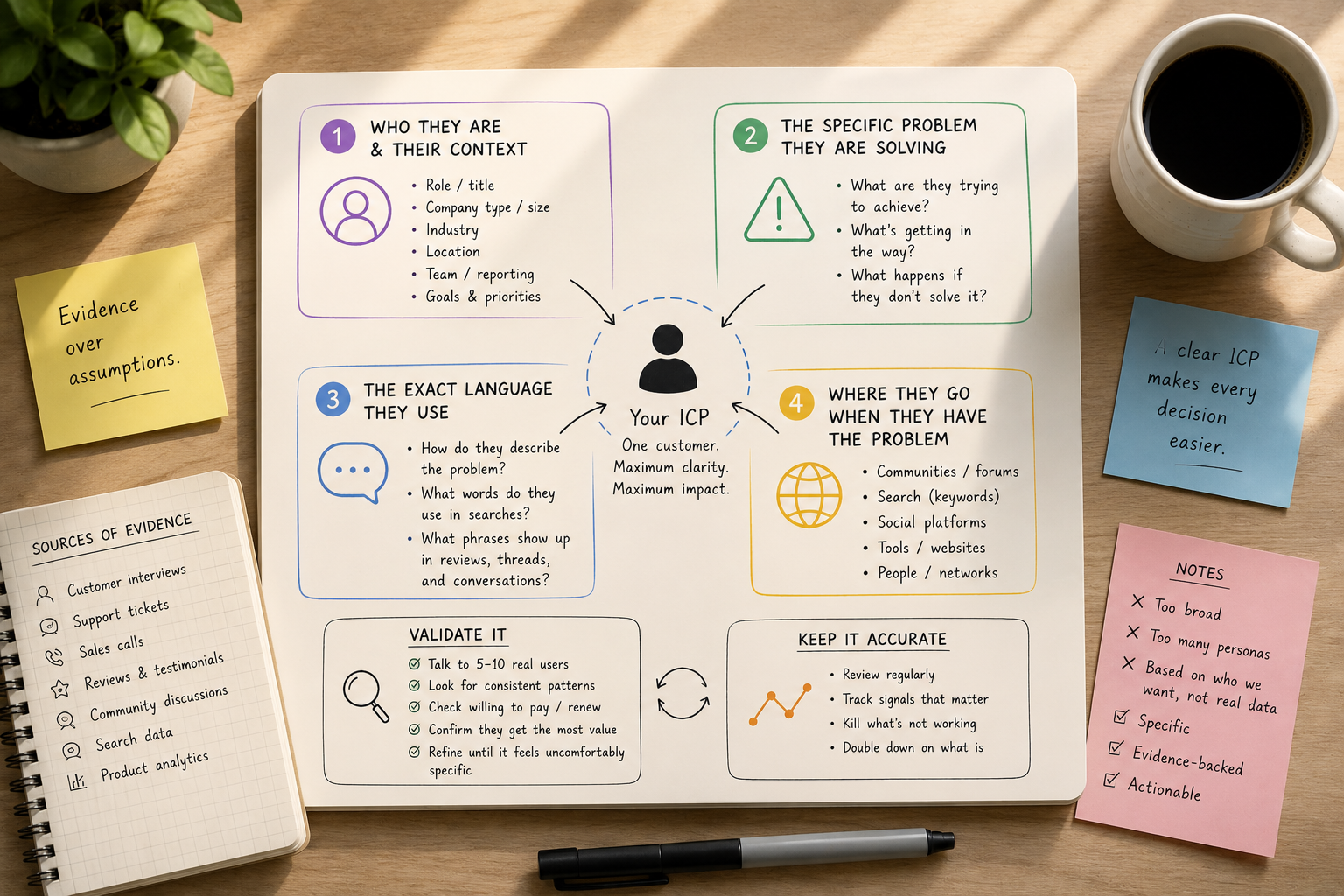
Before you can run a meaningful listening practice, you need to know who you are listening for. If that answer is still vague, our ICP definition guide is the prerequisite work.
The conversation is already happening. Your only job is to be in the room — and write down what they say.
Where does your ICP actually talk?
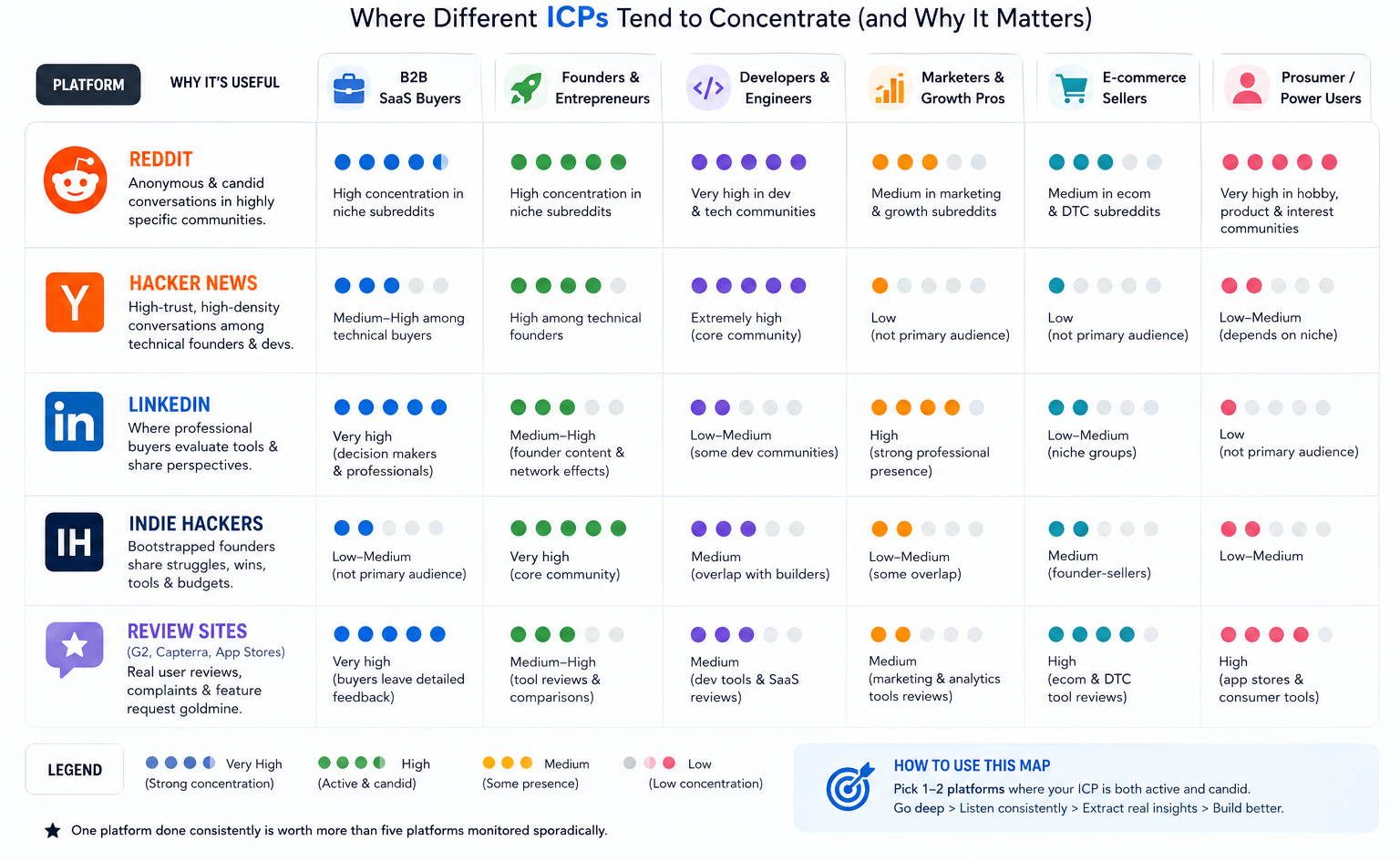
The mistake is monitoring everywhere. You only need the two or three places your specific ICP is both active and candid. Here is where different audiences tend to concentrate, and what each platform is good for.
Reddit. The highest-signal source for most B2B and prosumer ICPs. Reddit's anonymous posting culture means people are unusually candid about frustration, budget, and what they have already tried. Pew Research found that 22% of US adults use Reddit, and the relevant subreddits are remarkably specific — r/entrepreneur is different from r/SaaS is different from r/microsaas, and each has a different composition and signal quality for different products.
Hacker News. High-trust, high-density conversations among technical founders and developers. The "Ask HN" and "Show HN" threads in particular are dense with unmet needs and honest assessments. Algolia's Hacker News search lets you filter by points and date to surface only the threads that got real traction.
LinkedIn. Where professional buyers form opinions and evaluate tools. The comment sections under posts in your category are often more useful than the posts themselves — that is where practitioners push back, share alternatives, and describe what they actually use.
Indie Hackers. Where early-stage and bootstrapped founders describe their own struggles with unusual honesty, including about tools, budgets, and what has not worked. If you sell to founders, this is a goldmine.
Review sites. G2, Capterra, and app store reviews of your closest competitors are an entirely underused source. The "I wish it did X" complaints are a map of unmet needs your product could address — often more reliable than feature request votes, because they come from people who committed enough to actually pay for an alternative.
Pick where the candour is highest for your specific ICP and start there. One platform done consistently is worth more than five platforms monitored sporadically.
How do you do social listening for free?
You do not need a paid tool to start. A free stack will carry you through the first several months and prove whether the habit is worth building before you spend anything on tooling.
Native search. Reddit, LinkedIn, and Hacker News all have usable search interfaces. Build a short list of five to ten search terms — the problem phrased the way your ICP would phrase it, your competitors' names, and the category term. Save these searches and run them on a fixed schedule.
Google Alerts. Free alerts for your competitors' names, your category, and two or three problem phrases. Coarse, but reliable for catching blog posts, forum threads, and news coverage you would otherwise miss. Takes ten minutes to set up.
A capture document. The single most important free tool in the stack, and the one most founders skip. A plain document where you paste verbatim quotes with a link back to the source. Not a summary. Not your interpretation. The exact words, with the URL, dated. That document is where the raw material of your content lives between listening sessions.
When you outgrow free, tools like Brand24 or Mention automate the monitoring and save meaningful time. But they save time, not insight — the quality of what you do with captured language matters far more than how efficiently you collected it.
A monthly process that fits inside 90 minutes
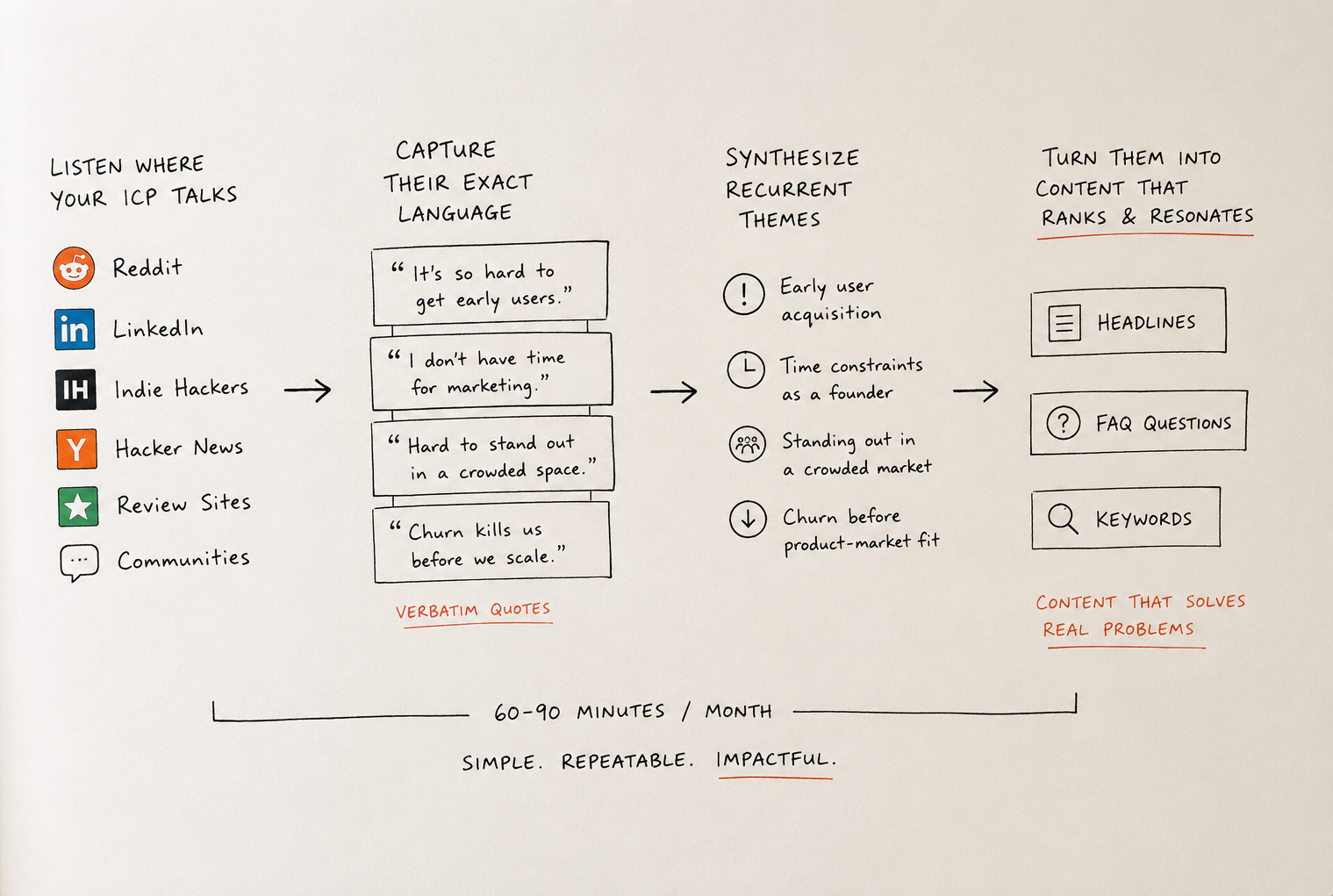
The goal is to make social listening a contained, repeatable habit rather than an open-ended rabbit hole. Here is the complete process:
Step one: capture as you go (a few minutes, ongoing). When you stumble across a sharp quote or a recurring complaint in the normal course of your week, paste it into your capture document with the link. No analysis. Just collect. This is the passive layer — low effort, high value over time.
Step two: run your searches (30 minutes, monthly). Work through your fixed search term list across your two or three priority platforms. Read the highest-voted replies and comments, not just the original posts — that is where the most useful language lives. On Reddit, sort by "Top" within the last month. On Hacker News, filter to threads with more than twenty points.
Step three: pull the patterns (20 minutes, monthly). Group your captured quotes into recurring themes. Which questions appear repeatedly? Which phrases cluster together? Which competitor complaints come up in similar words? You are looking for signal, not noise — a phrase that appears twice is interesting; one that appears ten times across different people is a content idea.
Step four: convert to actions (20 minutes, monthly). Turn each recurring theme into one concrete output. Drop these directly into your content calendar as fully specified ideas, grounded in evidence rather than assumption.
Orbit Media's annual blogging survey consistently finds that bloggers who plan before writing report measurably stronger results. A listening session that feeds your calendar with ICP-grounded ideas is exactly the planning they are describing.
What signals should you capture — and how?
Not everything you read is worth recording. Four categories produce the output worth capturing, and one rule applies to all of them: record direct quotes, not paraphrases. The literal wording is the point.
The exact language for the problem. How do they phrase what they are struggling with? "I can't keep up with content" is a different keyword and a different headline than "content marketing strategy." The literal phrase belongs in your headlines, your introductory paragraphs, and your FAQ answers. Paraphrase it and you lose the resonance.
Recurring questions. Questions asked repeatedly in communities are the questions people type into Google — often word for word. 91.8% of all search queries are long-tail and intent-specific, which means a question asked ten times in r/entrepreneur is very likely a keyword opportunity. These become FAQ entries that rank for the queries no standard keyword tool would surface.
Complaints about existing tools. When people describe what frustrates them about a competitor, you have found both a positioning angle and a product priority at the same time. These complaints are more reliable than feature request surveys because they come from people who paid for an alternative and still needed something more.
Workarounds. The duct-tape solutions people piece together reveal unmet needs more honestly than anything else. A workaround is proof that the pain is real enough to spend time on. If five people have independently invented the same workaround, you have found an underserved use case.
Tag each captured quote loosely — "headline," "FAQ," "competitor," "feature" — so the conversion step at the end of your monthly session is mechanical rather than requiring a fresh read of everything.
How do you turn findings into content?
Captured quotes are raw material. The value comes from what you do with them.
Headlines and intros. Take a recurring problem phrase and use it almost verbatim as a headline or opening line. When a reader sees "I can't keep up with content" as your article title and thinks "that's exactly what I said to my co-founder last week," you have earned an open that no competitor's polished headline buys.
FAQ questions. The questions people ask in communities map directly onto search queries and onto what AI answer engines surface. Lift the phrasing, write a tight 40 to 80 word answer that works without the context of the question, and you have FAQ content built for featured snippets and voice search. The phrasing should match how a real person would say it, not how you would write it in a white paper.
Keyword targets. Seed quotes become keyword candidates. Run them through a research tool to check volume and difficulty, then prioritise the specific, low-competition terms as described in our keyword research walkthrough for early-stage founders. The community language you capture is the starting point for that entire process.
Product and positioning signals. Repeated complaints validate that a problem is real enough to build for. Competitor complaints map weaknesses you can address in your positioning. Workarounds reveal use cases your roadmap might have underweighted. Research from GWI consistently shows that people increasingly use social communities to research products before buying — which means the conversations you are mining are the same ones shaping purchasing decisions in your category right now.
One good listening session should produce several weeks of content ideas, a handful of keyword targets, and at least one product or positioning insight. If it does not, you are reading too passively — go back to capturing verbatim quotes rather than skimming for a general sense of sentiment.
Where Sia fits
Sia runs the listening and the conversion continuously — monitoring the communities where your ICP talks, surfacing the recurring language and questions, and turning them into keyword-mapped content drafts grounded in what your customers are actually saying right now. You keep the judgement and the point of view. Sia carries the repeatable monitoring so the habit never depends on a quiet week. See how Sia works.
Start small this week. Pick the one community where your ICP is most candid. Set up a capture document. Block 90 minutes in your calendar for your first listening session next month. Do that consistently and you will never stare at a blank page wondering what to write — your ICP will have told you, in their exact words, precisely what they need next.